
 91 - 9810026819

Bandhavgarh National Park Fact File
| Location of Bandhavgarh National Park | : | Umaria District, Madhya Pradesh |
| Nearest Access to Bandhavgarh National Park | : | Umaria (34-kms) |
| Coverage area of Bandhavgarh National Park | : | 450-sq-kms |
| Climate of Bandhavgarh National Park | : | Winter : varies between0°C and 20°C, Summer: 36°C - 46°C |
| Major Wildlife Attraction in Bandhavgarh National Park |
: | Tiger, Leopard, Sloth Bear Chital,Sambhar, Nilgai,
Dhole, Chausingha, Jackal, Indian Fox,Striped Hyena, Wild Boar |
| Best Time Visit of Bandhavgarh National Park | : | Mid November to June |

About to Bandhavgarh National Park
Bandhavgarh an ancient stronghold of many kings, a land with history dating back to roughly 4000 years ago. This area had many dynasties ruling over it and finds mention in the Ramayan. This park once the private game reserve of the ruling family of Rewa also holds the distinction of being the home of the last White Tiger in the wild. The park is dotted with many caves with ancient rock paintings and carvings.
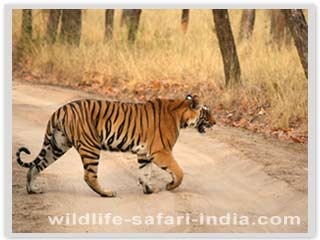
Tiger Bandhavgarh
The majestic Bandhavgarh Fort dominates center of the park with its own history dating back thousands of years. Various temples with statues depicting incarnations of Lord Vishnu dot the fort.
Bandhavgarh has an undulating landscape with around 32 hills some with flat plateaus and overhanging cliffs. Some perennial streams and rivulets crisscross this park creating fertile vegetation on the riverbanks. The area's combination of hills, rivers and valleys, meadows and marshes has created a unique biodiversity evident in the varied luxuriant vegetation. Bandhavgarh's forests are generally of the moist deciduous forest type.
The sheltered valleys are covered with moist evergreen Sal forests, while the drier slopes and plains are covered in mixed forest. Dense tracts of bamboo are scattered throughout the valleys. The Chakradhara and Rajbehra meadows are two major meadows of this park.
The chances of seeing a Tiger in Bandhavgarh is greater than in any of India's other forests. In summer's Tiger can quite often be seen at couple of major waterholes in the park like Chakradhara, Gopalpur, Jurmani and Barwanala. Other important cats in Bandhavgarh are Leopard and the jungle cat.

As many as 37 species have been listed for this park including 3 types of antelopes - Blue Bull, Chinkara and the Chausingha. Deer species like Chital, Sambar, Barking Deer, 4 species of bats, 2 types of squirrels, Indian Pangolin, Indian Porcupine, Palm Civet , Rare Indian Wolf, Indian Wild Dog, Ruddy and Common Mongoose, Honey Badger, Jackal, Wild Boar, Indian Hare, Common Langur and Rhesus Macaque.
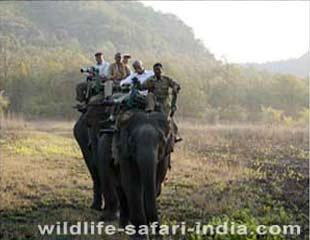
Elephant Safari Bandhavgarh
The park also has over 70 species of butterflies and around 255 species of birds. It provides ideal habitat for various species of Stork ( White-necked & lesser Adjutant), Hornbill (Malabar Pied & Common Grey), herons, cranes and birds of prey like Crested Hawk, Crested Serpant Eagle, Honey Buzzard, Shikra, Lesser Kestrel.
In winter Bandhavgarh attracts large number of migratory birds such as Nakta, Lesser Whistling Teal and Ruddy Shelduck. One can also see smaller birds like Gery Tit, Baya Weaver bird, Spotted Munia, the Green and Bearded Bee-eater, flycatchers and three species of parakeet- Alexandrine, Plum Headed and Rosering.
You may also like to see
| NATIONAL
PARKS INDIA ..................................................................................................................................... Ranthambhore National Park -» Bandhavgarh National Park -» Pench National Park Bharatpur Bird Sanctuary -» Kanha National Park -» Sundarban National Park Kaziranga National Park -» Corbett National Park ..................................................................................................................................... |